
thetis the nereid
before achilles, there was thetis, goddess of water

Hey Ancient Echoers!
Sorry for going a bit AWOL recently, I’ve been picking up some insane hours at the cafe which is great for funding my upcoming move to Australia (my boyfriend and I are going down under for a year🐨🌴!), but less great for finding the time to write these articles. One day I’ll adhere to a proper posting schedule, but unfortunately that day is not today.
I thought I’d write a mini-series on some of the mothers in the mythical world, and the roles they play in their hero-children’s lives (we tend to only hear about mums in Greek myth when they give birth to hero kids). Most people have heard about Achilles, Perseus, and Hercules (blah, blah, blah), so as is my duty, I’m going to completely ignore them and tell you more about the sidelined women in their lives<3
And today’s pick is Thetis!

Thetis
In Greek myth, Thetis appears as a sea nymph and one of the fifty Nereids, daughters of the ancient sea god Nereus. Interestingly, some sources argue that she was actually one of the earliest deities worshipped in Archaic Greece. One written record (only a fragment), exists attesting to her worship, and an early Alcman hymn exists that identifies Thetis as the ‘creator of the universe’.
But she’s generally just known today as ‘Achilles’ mum’. Ah, motherhood.
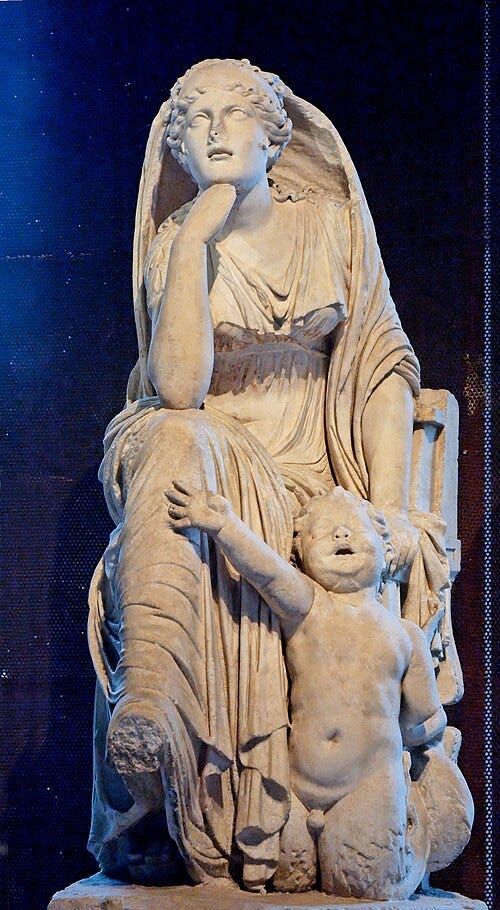
To start with, Thetis used to date Zeus and/or Poseidon, but then there was a prophecy that said her son would grow up to be greater than his father, so they immediately booted her down to Earth and ordered her to be married to Peleus, a mortal man.
Thetis, fairly unhappy with this downgrade, flat-out refused (some might say this was fair enough). So Peleus, man that he was, snuck up on Thetis while she was sleeping and grabbed her so tightly that she couldn’t escape, even while she shape-shifted into different animals to try and escape him (she’s a nereid, they can do stuff like that).
Thetis eventually tired, and Peleus took this opportunity to rape her so that she’d have to agree to marry him.

At this rate, it wouldn’t take much for his son to grow up to be greater than him.
The wedding of Thetis and Peleus is something I have actually already written about due to the eternally intertwining nature of all Greek myths, so I’ll share a snippet here. This is from my newsletter on Helen of Troy, which I’ll link below for you if you’re interested !! It’s quite insane but also fun.
A sea-nymph, Thetis, and king of Phthia, Peleus, are getting married. In the future they will be the parents of the famous Achilles, which is quite interesting but not too important right now. Every god and demigod you can imagine had been invited to the wedding, apart from Eris, the goddess of discord and strife. Because who wants strife at their wedding??
Anyway, Eris predictably turns up to cause some strife anyway, and rolls a lovely golden apple across the floor. It’s engraved with the words ‘tei kalliste’, for the most beautiful. The apple stops on the floor, within sight of Athena, Hera and Aphrodite, all of whom think the apple is for them. When it’s discovered that the sender and recipient of the apple are both unclear, all hell breaks loose. Thetis can wave goodbye to her gorgeous wedding, because now there are three angry goddesses on the rampage.

So Thetis’ and Peleus’ wedding led to the Judgement of Paris, which was instrumental in causing the Trojan War. But Thetis’ role in the drama didn’t stop there, because she soon gave birth to a baby boy whom she named Achilles.
In her quest to keep her child from harm forever, Thetis took some pretty extreme measures, but sources differ on exactly what extreme measures she took. One source tells of how she attempted to burn her son’s mortality away, anointing him in ambrosia and letting him sleep in fire at night. Peleus is said to have discovered his wife putting their son into the fire one night, and quite rightly, absolutely freaking out.

It’s said that Achilles’ one vulnerability (his heel) came about as a result of his father snatching him out of harm’s way before Thetis’ plan could be completed.
Another source, and the more commonly known (and just better) version of this myth, is that Thetis dipped the baby Achilles into the River Styx to grant him invulnerability. She held him by his heel, which was the only part of him not to be submerged, hence Achilles’ Heel.
After this, Thetis abandoned her child, too afraid to love him while he wasn’t completely protected from harm. There was a prophecy (at some point) about Achilles which said that he would either live a boring, long life, or a glorious, short one, so Peleus waited until Achilles was old enough and then gave him to Chiron the centaur to raise, hoping to create a warrior out of his son.
When the Trojan War broke out (the timeline is slightly skewed here, as is so often the case with Greek mythology, so we’re going to ignore it), Thetis arrived straight back onto the scene to whisk Achilles away to hide him at the court of Lycomedes on the isle of Scyros by disguising him as a girl, in what is possibly my favourite moment in all of Greek mythology.

This clever plan was no match for Odysseus, however, sent by Agamemnon to sniff the boy out, famed as he already was for being a fearsome warrior even at seventeen. So Achilles was carted off to war despite Thetis’ best efforts, and fought for nine years without issue.
Now, I’m not going to get into the whole drama that happens with Agamemnon and Achilles at the end of the war (you can go and read The Song of Achilles by Madeline Miller for all that juicy gossip), but basically Achilles ended up refusing to fight until Agamemnon gave back his war prize: a Trojan girl. His ‘best friend’ (or lover, if you’re not a coward), Patroclus, has also just been killed in battle whilst pretending to be Achilles, dressed up in his armour, so he’s pretty distraught about that too.
Thetis plays a pretty huge role in this final stage of the ten year war, delivering Achilles some armour handmade by Hephaestus himself which he then uses to defeat Hector in battle, his biggest rival in the war. She also convinces Achilles to return Hector’s body to his family, but only after he’s completely defiled it by dragging it around the walls of his city several times tied to the back of his chariot.

Boys will be boys I guess.
Achilles is eventually killed too, and even though Thetis had known all along that this would happen (remember that prophecy?), she still laments the loss of her only child and beloved son.
I think the point of this article/series is that Thetis (and others) are compelling examples of how mythology frames maternal figures primarily through their relationship to specifically male heroes. Despite her status as a sea goddess with considerable power, Thetis is hugely defined by her role in Achilles’ life: shaping his fate, protecting him, and eventually mourning him.
Her actions are pivotal, yet her character isn’t centre stage, except for maybe when Achilles dies, but is that only because… he’s dead? Her divinity and agency are expressed totally in service to her son’s narrative, not her own. Does this pattern reflect a tendency in ancient and modern storytelling to focus on mothers as supporting figures? Essential, but ultimately secondary?
Heavy stuff. Let me know what you think below!! And now, onto the fun bit.
SOME ART
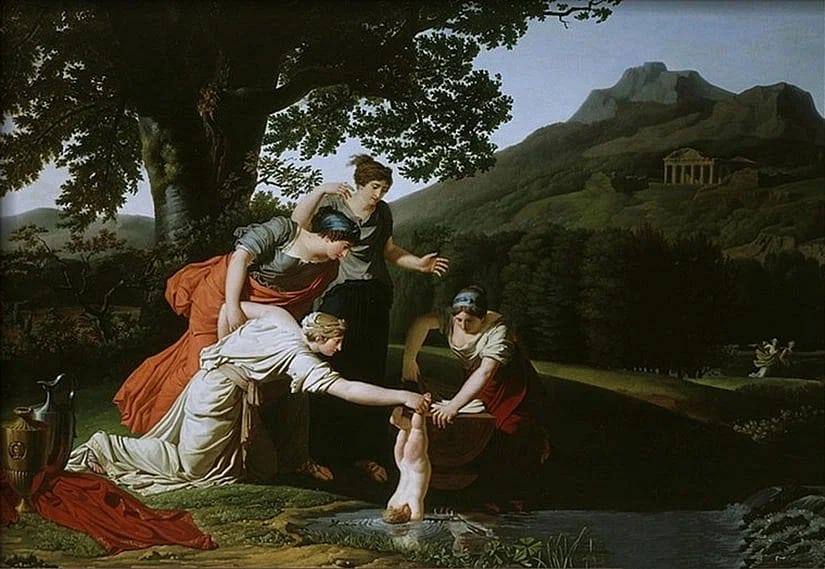
This really just couldn’t look any more incriminating. It’s hilarious.
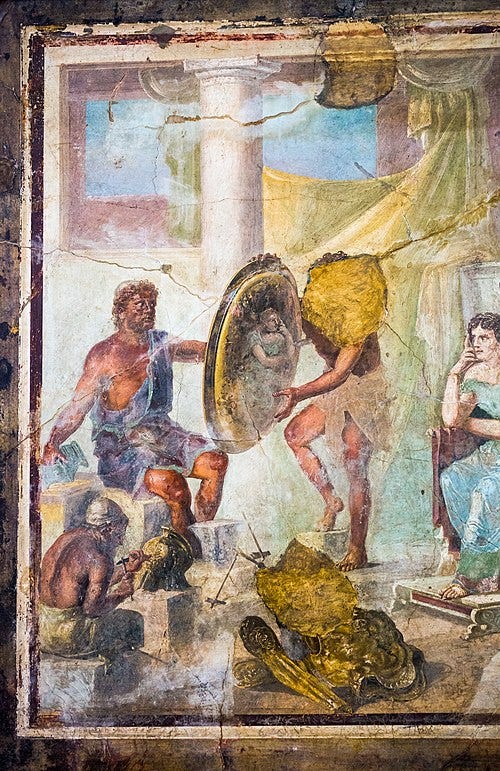
Description from Theoi: “Hephaestus (Roman Vulcan) presents Thetis with a new set of armour for her son Achilles in a scene from Homer's Iliad. The goddess is seated on the right beside smith's wife, Charis. Her reflection is also visible on the mirrored surface of the shield. Two Cyclopes assist the god in his work--one holding the shield, the other seated working on the helm.”
I am so very obsessed with the reflection in the shield.
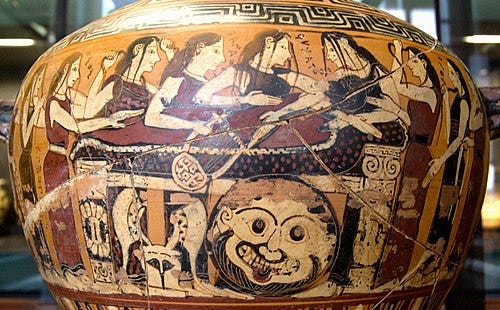
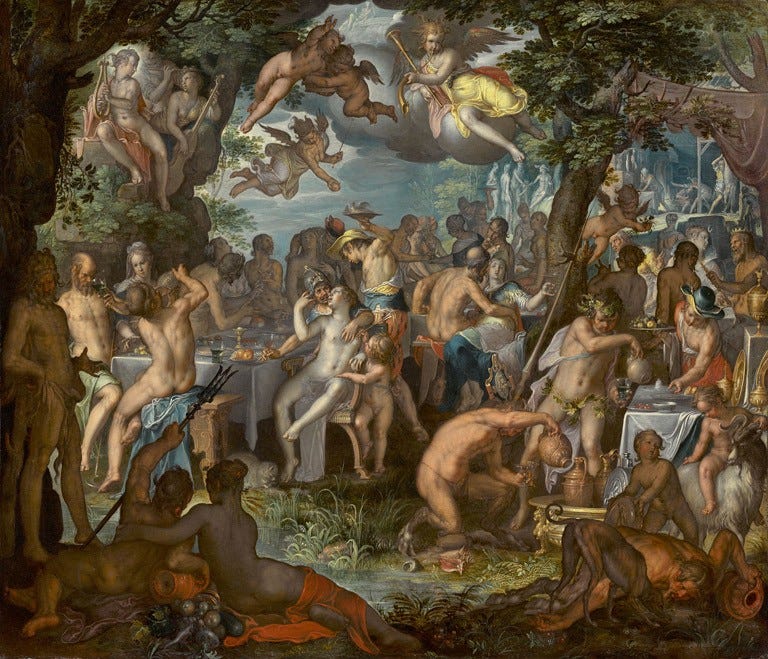
You can use this website to have a closer look at each individual scene going on in this painting: there’s so much to look at! Check out Eris flying over just to the left of the centre with her golden apple, and the judgement of Paris to the right at the back!
THE END
That’s it from me today, as always I hope you enjoyed and/or learned something new !! Let me know if you want me to continue this mythical mothers series, or who you’d like me to write about next !
Until next time🏺💗
The drama between Agamemnon and Achiles is just so entertaining. Both of them are so petty.
I love that convention of portraying the dudes as "we're naked, but still wearing helmets".